The Commerce of Conservation: Nature-Based Tourism in Taney County

24 Aug 2026
News, Whitepapers
Nature-Based Tourism as Economic Strategy
Every golfer who tees off from inside a cave at Big Cedar Lodge takes a photo before taking a swing. Every angler on Lake Taneycomo, every rider clearing a jump at Howler Bike Park, every family filling a basket in a Walnut Shade orchard does something similar, whether they mean to or not: they generate content, and that content travels. In Taney County, this dynamic is not incidental to tourism. It is increasingly the mechanism through which tourism works.
Nature-based tourism deserves examination on those terms specifically. It is not simply that Taney County's landscape is scenic, though it is. It is that the landscape functions as an economic asset whose return compounds through visitor-generated media as reliably as it compounds through visitor spending. Understanding that mechanism, a kind of marketing echo cycle in which pristine, well-managed natural assets generate their own free and ongoing publicity, changes how the county should think about investment in its outdoor and agricultural tourism products.
The Economics of the Outdoors
Outdoor recreation is not a marginal slice of the national economy. According to the U.S. Bureau of Economic Analysis (BEA), the sector generated $1.3 trillion in gross output in 2024, with value added accounting for 2.4 percent of GDP and supporting more than 5.2 million jobs nationwide. Nature-centric destinations see a particular advantage within that broader figure. Research on nature-based tourism shows that each additional dollar of visitor spending in nature-centric areas can generate between $1.53 and $1.83 in real income gains as that spending circulates through the local economy.
That multiplier is amplified by a second, less obvious dynamic. Social media now carries more influence over travel destination choices than television, news, or word of mouth, and a majority of travelers report relying on photos of a place to decide whether to visit it. A landscape generates its own advertising if enough visitors are willing to post photographs of it online. Taney County's outdoor and agricultural assets, examined individually, show how directly that principle translates into local economic activity.
Golf Built Around the Land, Not on Top of It
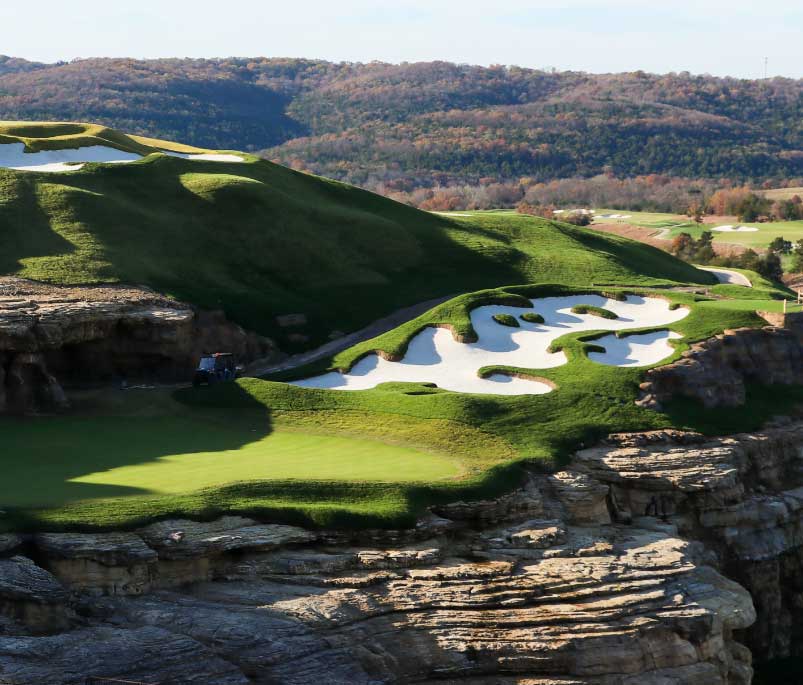
Big Cedar Lodge, founded by Bass Pro Shops owner Johnny Morris in Ridgedale, was voted USA Today's Best Golf Resort in America for 2025. Its newest course, Cliffhangers, opened that July with a signature hole that tees off from inside a cave, through a waterfall, to a green far below, a feature built to be photographed nearly as often as it is played.
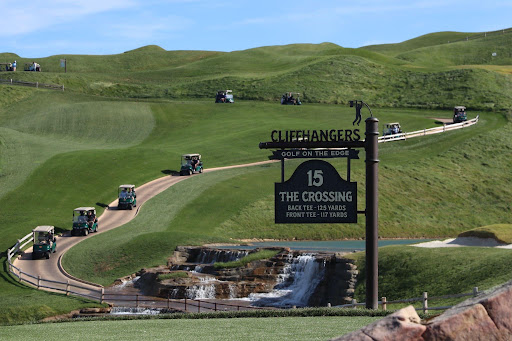
What distinguishes the resort further is certification, not just design. Big Cedar is the first golf destination in the world to have every one of its courses designated an Audubon International Signature Sanctuary, a distinction that requires ecologists to be involved from the design phase onward and ongoing environmental audits. Close to 80 percent of the resort's fertilization is done organically, and irrigation is engineered to limit runoff into Table Rock Lake. With Cliffhangers' addition, all six of Big Cedar's Nature Golf courses now carry the certification, a rare case of an environmental credential functioning as a headline marketing asset rather than a footnote.
The certification is not incidental to the resort's commercial success. Conservation-minded design produces the limestone and water features that make the courses distinctive, and distinctive courses generate the visitor media that keeps a destination relevant between major tournaments. Moreover, shoulder-season golf travel in spring and late fall gives Ridgedale and Hollister demand outside the summer peak that otherwise dominates Branson's broader visitor economy.
Trails Built for a Full Day, Not a Quick Stop
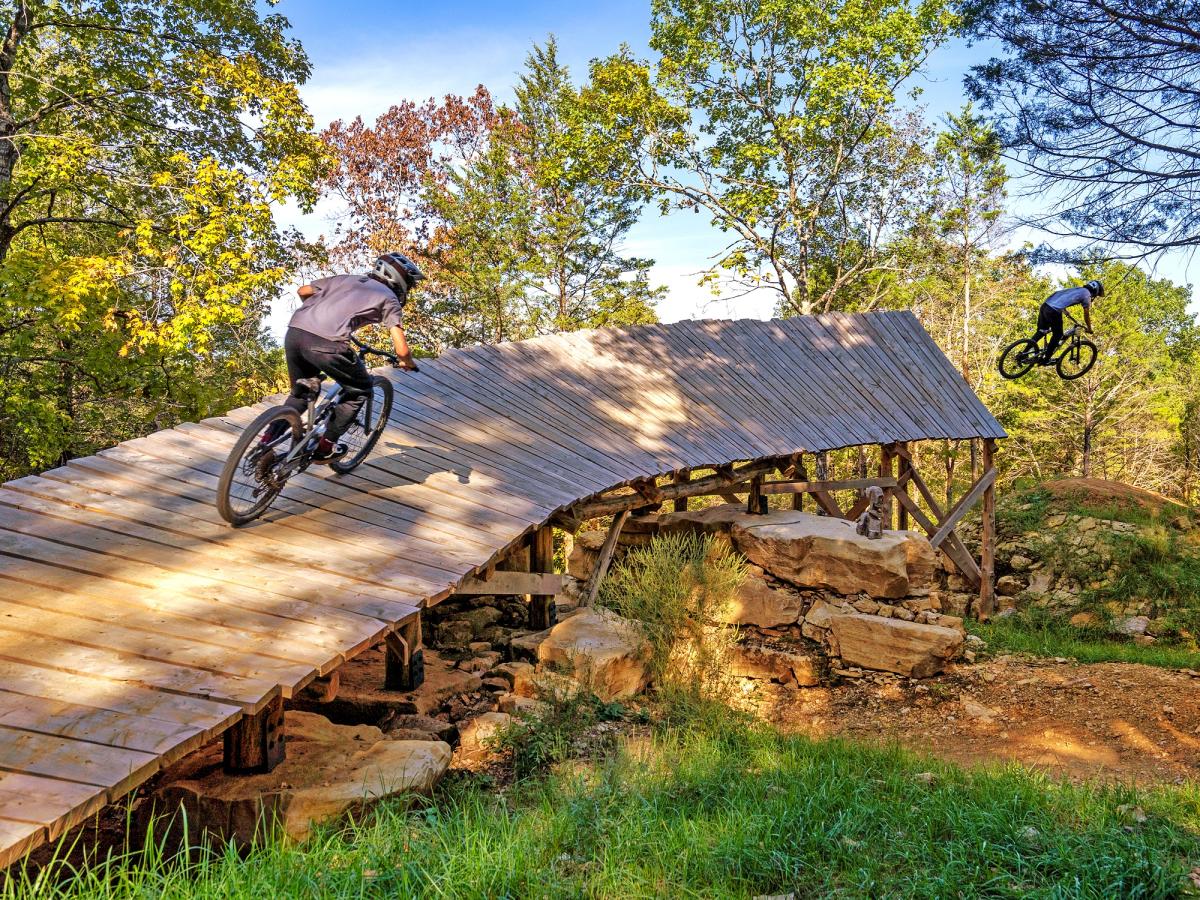
Northern Taney County has developed its own outdoor identity around trails. Howler Bike Park, a 200-acre, family-owned mountain bike park in Walnut Shade, offers twelve downhill trails across roughly seven miles of terrain, with military-style shuttle trucks carrying riders back to the top between runs. Its on-site restaurant and glamping give visitors a reason to spend the better part of a day rather than pass through. Howler draws riders who plan a trip specifically around its trails, not visitors who happen upon it en route to somewhere else, and that is a different kind of pull than most of Walnut Shade sees today. It gives the community a recreational identity that is still taking shape: not yet the kind of lodging-and-dining cluster that has formed around Hollister or Ridgedale, but no longer simply a drive-through point either. Bradleyville shows a similar pattern a bit further along, where access to the Hercules Glades Wilderness has built real, sustained outdoor traffic without yet consolidating into a fully built-out destination.
Closer to Branson, the White River Valley Trail System offers four loops across roughly 11 miles, built partly on land used during the construction of Table Rock Dam, with elevation ranging from 710 to nearly 1,200 feet and a preserved farm homestead along the way. The Ruth and Paul Henning Conservation Area, 1,534 acres straddling the Taney and Stone county line, adds 5.6 miles of hiking trails through limestone glades and a lookout tower, free and open to the public.
Every dollar reaching Taney County's outdoor economy has the potential to work well beyond its face value. For example, every dollar spent on nature-centric tourism has been shown to generate between $1.53 and $1.83 in local income as it circulates through the economy. Public investment in trail network connectivity can generate even greater returns; across the country's trail networks, the total economic value roughly quadruples when trails are used as active-transportation corridors in addition to recreational assets.
On the modest end, green space works as inexpensive infrastructure in its own right — reduced stormwater treatment costs saved Philadelphia's park system $5.9 million in a single year — while proximity to a park reliably raises nearby property values and factors into where employers chasing quality-of-life-minded workers choose to locate. On the higher end, trails that connect residents directly to jobs, schools, and commercial districts, not just to recreation, compound that return further: Rails to Trails Conservancy's national modeling projects that completing those connections could roughly quadruple the country's annual economic return from active transportation networks. That kind of connectivity is already visible at the neighborhood scale within Branson, where the Roark Creek Trail links North Beach and Branson Landing to Stockstill Park, which connects onward by sidewalk to Historic Downtown Branson. Across Taney County, parks and trails function as critical pieces of health infrastructure. A multinational study examining the relationship between green space and physical activity in high-income countries, including the United States, demonstrated a benefit-to-cost ratio of $3.10 for every $1.00 invested.
For the rest of the county, where scenic trails attract visitors from outside the immediate area, destination spending provides a direct commercial benefit. Updated to 2026 dollars, day-trip spending has been measured at $20.24 on a Maryland interstate trail corridor, $49.70 on a Pennsylvania rail trail, and $44.22 across six Illinois trails. Overnight stays substantially increase that spending as well: on the same Maryland interstate corridor, overnight visitors spend roughly seven times as much per day as those just passing through. In Taney County, trail networks do double duty: they extend a typical visitor's stay beyond Branson's entertainment district, and every descent, overlook, and creek crossing becomes the kind of image that circulates well past the visit itself.
One additional mechanism remains for growing the return on Taney County's trail investment: connectivity. Taney County's own trail assets currently function more as individual destinations than as a connected system, each drawing its own visitors without linking to the others or to the county's smaller communities. New York's 750-mile Empire State Trail shows what closing that kind of gap can generate: $5.43 in economic output for every dollar invested, and enough pull to turn Schuylerville, a small New York state community with a population of 1,350, into a genuine overnight stop along the route rather than a place travelers pass through. Extending that same kind of connectivity across Taney County is worth exploring as a longer-term investment: a more connected trail network could spread nature-centric tourism beyond Branson's core, giving smaller communities across the county a stake in the same visitor economy, while also extending the length of a typical stay, turning a single-destination day trip into a multi-day, multi-stop visit.
Water, Bluffs, and Built Adventure
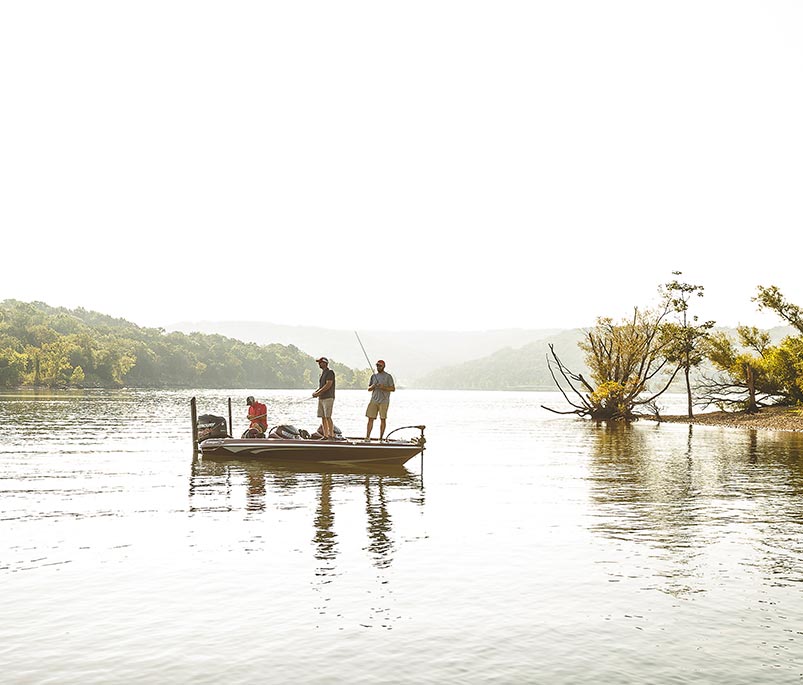
Taney County's water access is concentrated where it can do the most commercial good. On Lake Taneycomo, outfitters including Scotty's Trout Dock and Lake Cruise Rentals put kayaks and paddleboards into the water steps from Branson Landing, feeding foot traffic directly into the district's restaurants and retail. Table Rock State Park's marina, straddling the Taney and Stone county line on the shores of the 43,000-acre lake, extends the same access south of the city.
The county's more unusual water-based draw sits in Forsyth. Shadow Rock Park, a public, city-run park on Bull Shoals Lake, includes a short limestone bluff that climbers use for deep-water soloing, routes climbed without ropes or harnesses, where the lake itself serves as the landing zone. It is a warm-weather activity best suited to the height of summer, and it turns a swimming spot into a genuine, if niche, climbing destination without requiring any fixed anchors or bolted routes.

For a more accessible, all-weather complement, Fritz's Adventure in Branson offers 80,000 square feet of built vertical challenge: a 48-foot City Wall, a multi-story ropes course, and an outdoor Via Ferrata, a protected climbing route that lets visitors of nearly any skill level scale real height with a harness and a guide. On a rainy afternoon or a slow winter weekend, Fritz's gives the entertainment district a reliable draw that does not depend on the weather cooperating.
Farms Built to Be Photographed
Agritourism has quietly become one of the county's most measurable success stories. Inspiration Ridge Farm, in Walnut Shade, has a sharp economic story. The 4.67-acre property was sold in 2021 for $225,000 as an unremarkable converted country store. Its new owners, who first operated the property as Willow Spring Farm, developed it into a working flower farm and twelve-variety apple orchard with an Airbnb cottage, a separate barn rental, a greenhouse, and a timber-frame event pavilion. When the property returned to market in August 2024, as a turnkey agritourism business, its list price was $535,000, more than double its prior value, and sold within eight days.
Sycamore Creek Ranch, 272 acres along Lake Taneycomo, pairs Conestoga glamping wagons and a renovated barn with a full calendar of seasonal draws, including a fall roundup, barn dances, and a wintertime event called Behold the King, alongside more than a mile of private shoreline for fishing and paddling.
The gap between those two figures is among the clearest evidence available that curated, nature-based development creates value a conventional appraisal would not predict from acreage or square footage alone. Visitors are not simply renting a cottage or picking apples; they are paying for an experience built specifically to be shared, and that experience turned raw agricultural land into a commercial asset in three years.
Conservation as the Long-Term Return
What ties these categories of investment together is not the type of activity on offer, golf, biking, paddling, or farming, but the underlying logic. In each case, protecting or curating the natural landscape is what makes the commercial product valuable in the first place. Big Cedar's Audubon certifications, the limestone bluff standing over Bull Shoals Lake at Shadow Rock Park, and Inspiration Ridge Farm's flower fields all depend on the same asset remaining intact and attractive. That is a meaningfully different relationship between conservation and commerce than exists in most industries, where environmental protection is typically treated as a cost of doing business rather than the source of the product's value.
For Taney County, that relationship offers a durable framework for continued investment: a well-managed trail, bluff, or orchard keeps generating its own audience long after the initial capital has been invested.
Contact Taney County Partnership today to explore how the county's natural assets can continue to shape its economic future.
More Topics